

FWI, FWM and JMI
PSS-GEO performs services using internally developed codes and workflows for FWI, FWM and JMI. The basis of the solutions originates from academic developments of the Delphi Consortium and has been further developed and implemented by PSS-GEO. For efficient 3D production jobs, we offer the use of external cloud and supercomputing resources, while tests and smaller jobs can be run on our own cluster.
Full Waveform Migration (FWM) allows seismic imaging and inversion within a full-wavefield approach. Conventionally, seismic processing consists of pre-migration steps, including de-noising and de-multiple, followed by migration and post-migration processing. Full-wavefield methods allow more of the recorded wavefield to be used directly for imaging and inversion.
Joint Migration Inversion (JMI) jointly updates the velocity model and seismic image, providing an alternative to conventional workflows involving separate velocity-model building and migration. PSS-GEO has further developed the technology towards multiparameter full-waveform solutions, including Vp, Vs and density, using multiple wavefield components. Current tests demonstrate good and stable results from the Vx and Vz components, while recovery of the other parameters benefits from staged inversion.
The development combines FWM, JMI and multiparameter full-waveform inversion within the PSS-GEO Subsurface platform, providing an integrated environment for full-wavefield imaging, model updating and multiparameter inversion. Our recommended workflow uses MP-FWI (JMI) to obtain low-frequency multiparameter models as input for subsequent full-band Rune Inversion, combining full-wavefield model building with high-resolution multiparameter inversion.

Test parameters on local server
Deploy stable tested computational jobs to
cloud
Monitor and adjust online
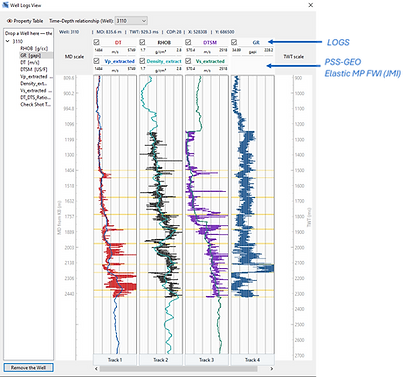

The field data example is from the most challenging Barents Sea region:
